Buffalo Grove sits about thirty-five miles northwest of Chicago and, unusually for a village this size, spans two county lines. The village describes itself as covering more than 9.25 square miles in both Cook and Lake Counties, and that detail decides more about your move than most people expect. Anything inside fifty miles of Chicago is an hourly, non-binding move rather than a fixed sum agreed in advance, and Illinois Commerce Commission rules separately allow hourly pricing for moves of fifty miles or less. The county boundary then matters on its own: a household-goods move made wholly inside Cook County is governed by the mover's filed state tariff, while a move that begins or ends outside it is rate exempt. Two Buffalo Grove addresses a few streets apart can land on different sides of that line, so it is worth knowing which side you are on before you ask anyone for a number.
The second thing worth settling is physical, and you can settle it tonight. Go outside and look at where a moving truck could actually stand on your block. Village code requires a parked vehicle to leave eighteen feet of roadway clear for moving traffic, and forbids blocking the use of any driveway, including a neighbour's. No permit anywhere in Buffalo Grove lifts either rule. The distance from the nearest legal spot to your front door is carry time, carry time runs in fifteen-minute increments once the three-hour minimum is used up, and it is the one variable you can change for free before move day.
What follows is the Buffalo Grove version of the things that actually move an estimate here: the streets where parking is barred outright, the overnight rule that stops a loaded truck waiting outside, the snow ordinance that turns a winter move into thirty-minute working windows, and a housing stock whose median home dates to 1981, where furniture tends to get stuck on a split-level landing rather than at the front door. Buffalo Grove is served from the company's Chicago-area operation. For the wider metro picture see Chicago movers, and for other markets in the state, movers in Illinois.
Where a moving truck can legally stand on your street
In Buffalo Grove this is the variable that moves the bill most. A parked vehicle may not reduce the usable width of the roadway for moving traffic to less than eighteen feet, and may not block the use of a driveway. Section BG-11-1303.C covers both. On a cul-de-sac with cars along both curbs, eighteen feet often is not there, and the truck ends up standing wherever it legally can.
On some streets the answer is a flat no. Parking is prohibited outright within village limits on McHenry Road (Illinois Route 83), Dundee Road (Illinois Route 68), Half Day Road (Illinois Route 22), Buffalo Grove Road, Arlington Heights Road, Weiland Road, Deerfield Parkway, Aptakisic Road and Prairie Road. The whole village is also closed to parked vehicles between two and six in the morning, every day of the year, under section BG-11-1308. That rule has an awkward consequence: a loaded truck cannot wait outside overnight. It cannot sit on the lot instead either, because a commercial vehicle parked on residential property in Buffalo Grove is capped at dimensions smaller than any moving truck. So a move here is planned to load and clear the curb inside the working day. That is why the estimator asks about volume before agreeing to a late-afternoon start, and one of the reasons crew size is a scheduling decision as much as a pricing one.
If your address is in the Mirielle Phase I, Tenerife or Waterbury Place subdivisions, or on Kingsbridge Way, Brandywyn Lane, Radcliffe, Beechwood Road, Weidner Road or Strathmore Court, check the date against the school calendar too. Each of those carries a time-of-day parking ban on school days, and several run from seven in the morning until four in the afternoon, long enough to cover an entire move-out. The same move on a non-school day gets materially better street access at no extra cost.
No moving permit exists here, and nothing lifts the rules that do apply
Buffalo Grove runs no moving-truck permit and no temporary no-parking permit. The village's licences and permits list covers building work, contractors, businesses, rentals and special events, and nothing in it applies to a household move. If you have read advice about reserving curb space or posting signs, that is a big-city process and it does not exist in this village.
What Buffalo Grove does run is an oversize and overweight permit, issued by the Police Department, and it is worth knowing where its thresholds sit so you can stop worrying about it. The village publishes the limits as 80,000 lb gross weight, 8 ft 6 in wide, 13 ft 6 in high and 42 ft for a single vehicle. A standard residential moving truck is below every one of those, so an ordinary house or apartment move in Buffalo Grove needs no permit at all. A handful of named segments do carry posted weight limits (Armstrong Drive between Lexington Drive and Weiland Road, Johnson Drive north of Milwaukee Avenue, and Checker Drive between Arlington Heights Road and McHenry Road), and the crew routes around posted limits as a matter of course.
So here is the trade-off. WellKnown does not reserve curb space, book elevators or obtain building approvals, because in Buffalo Grove there is nothing to apply for and the standing restrictions cannot be waived. What the crew does instead is plan the approach around what you confirm: which side of the street is legal, how far the carry is, whether the driveway is clear, and whether the date falls in a restricted window. Skip that conversation and the move still happens. The crew simply parks farther out, carries longer and works around access nobody told them about, and on an hourly job every one of those minutes is on the clock.
Moving between November and April
A normal season here brings about thirty-eight inches of snow, with roughly eleven of them falling in January alone, and measurable snow usually arrives by mid-November and lasts into early April, according to National Weather Service normals for the Chicago area. Snow on the ground is a normal condition here for something close to half the year, so it is worth planning around rather than hoping past.
The village ordinance is unusually specific about what that means for a truck at the curb. Under section 10.08.010, once snow begins to fall, and for a full day after it stops if depth on the street exceeds two inches, parking on a public street is unlawful, and the restriction runs longer while plowing is still under way. One exception matters: a vehicle may park for up to thirty minutes at a time while actively loading or unloading. In practice a winter move becomes a relay of half-hour working windows at the curb, which is exactly two of the fifteen-minute billing increments. A larger crew does not change that structure. It changes how many windows the job needs.
Two things are yours to control the night before. Clear and salt the driveway and the path, because a truck working from private ground is not subject to the street clock at all. And keep that snow out of the road: depositing driveway or sidewalk snow onto a public street is separately prohibited under section 10.08.020. If the street itself has not been cleared, note that the village plows only the roads it maintains and says plainly that state and county roads inside its boundaries are maintained by the jurisdictional agency. On the arterials listed above, the village is not the office to ask.
What the hourly rate covers, and what sits outside it
Buffalo Grove falls inside the fifty-mile line, so this is an hourly, non-binding local move. The rate depends on crew size and the number of vehicles, chosen with you from the work the job actually needs. The published floors sit on the cards further down this page and on the pricing page. Take the tier that matches your home. Three movers and a truck start from $160 / hour, so multiply that by the three-hour minimum and add the thirty minutes of standard travel time that goes onto every local job, and you have your floor. After the minimum, time runs in fifteen-minute increments, which is how the carry distance you measured earlier turns into money you can predict.
Illinois puts a useful distinction underneath all of this. The Commerce Commission's own guidance separates a rate quote, meaning an hourly figure on its own, from an estimate, which has to name the crew, the vehicles and the hours. Movers here must confirm the estimate in writing before service begins, and it must state the number and size of trucks, the number of movers, and the estimated hours including travel time. The state also requires any minimum charge to be disclosed in writing beforehand, which is where the three-hour minimum belongs. Two checks follow from that, and both are yours: read those four line items before anyone starts, and on the day, compare the crew and vehicle count written on the bill of lading against the estimate. If a fourth mover was added without your written agreement in advance, that person cannot be billed for.
The rate carries the movers, a fully equipped truck, fuel and tolls, the protection equipment (dollies, two-wheelers, furniture pads, shrink wrap, tape), loading and unloading, basic furniture disassembly and reassembly, and basic liability coverage at the released-value level, which Illinois sets at sixty cents per pound per article, with higher coverage available for an added charge against the value you declare. There is no separate equipment charge, and no separate charge for stairs. Packing is not part of a standard move: it is quoted per job as full, partial or item-specific, and you can supply your own materials or we can supply them. See packing services. Storage applies when it is confirmed as part of the plan, whether into storage, out of it, or as the final delivery point, on moving and storage. Anything over two hundred pounds, and anything fragile enough to need extra padding or custom crating, gets confirmed at the estimate rather than discovered on the landing, because what it adds depends on the item, the access, the crew required and the protection it needs.
A move out of Buffalo Grove that crosses the fifty-mile line is a different product: a binding flat rate from $750, set by distance, exact inventory and access, and priced before the date is booked. See long-distance moving. Within the village, local moving is the hourly service described above. Timing on any move is given as a range, never a fixed hour, because it turns on inventory, access, parking, building rules, packing readiness, traffic, weather and how the previous job ran.
Stairs, split-levels, and buildings with rules
Buffalo Grove's housing stock is unusually uniform in age, and that shapes the work. Nearly three in five homes here went up between 1970 and 1989 and the median unit dates to 1981, with barely one in a hundred built before 1940, according to Chicago Metropolitan Agency for Planning community data. That means split-levels, bi-levels and two-storey subdivisions with finished basements: half-flights between every zone, and a ninety-degree turn at the landing that is narrower than the doorway below it. The piece that will not clear is usually a king box spring, a deep chest of drawers or an oversized sectional, and it is usually the turn rather than the doorway that stops it. Measure the narrowest point of that turn and the narrowest doorway, and send both numbers with your inventory.
The same data explains two other things. More than a third of homes here have four or more bedrooms, and a finished basement is close to standard, which is why below-grade contents are the most under-reported part of a Buffalo Grove inventory, and why the hourly rate can change if the job turns out significantly larger than described at the estimate. Walk the basement, garage and attic before the call. For larger or more complex homes a virtual or in-person walkthrough confirms inventory, access, heavy items and scope before the date is booked, which is the point at which surprises stop being expensive.
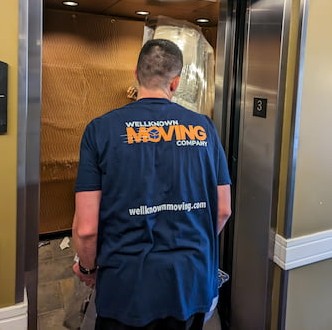
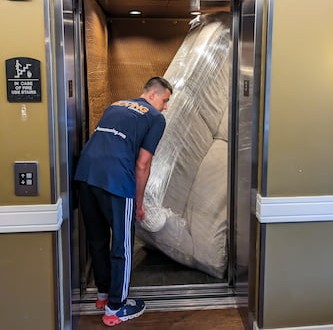
Roughly one Buffalo Grove home in seven sits in a building of twenty units or more, and those are the addresses with rules. The Clove, the redevelopment of the former Town Center, added a seven-storey building of 275 to 300 apartments whose first residents moved in during January 2025: one service elevator, a designated route through the building, and a property manager who sets the window. When a building or association asks for a certificate of insurance, we can issue one as soon as you confirm five specifics: the building name, the property manager's contact, the required coverage limits, the additional insured wording, and the move date with the address. Most of the village is detached single-family and never needs one, so treat it as a question to ask rather than an assumption to make. If you are in a condo or one of the village's many attached townhomes, ask in the week you book rather than the week you move, because a volunteer board plus a management company approves on a meeting cycle and not on request. If you rent, note that every rented home in Buffalo Grove needs an annual village rental licence held by the owner, so there is always an identifiable owner of record to ask about move-in rules.
Who does what on a Buffalo Grove move
Most of what goes wrong on a move is a gap between what the customer assumed was handled and what the crew was told. This is the split, in the order it comes up.
- Which county the address sits in. You confirm it on the village community portal, which answers it per address. We apply the pricing basis Illinois requires for that address and state it on the estimate before the date is booked. Settle it at estimate stage and it never becomes a conversation later.
- Where the truck can legally stand, and how far that is from the door. You walk the street, count the parked cars and pace the distance. We set crew size and estimated hours from that distance and plan the approach around posted limits. Carry time is billed in fifteen-minute increments, so a long carry becomes arithmetic instead of a surprise.
- Moving the household cars off the driveway the night before. You do it. We work from the driveway when it is clear, which takes the street rules out of the job entirely. Nearly half of households here keep two vehicles and about one in seven keeps three or more, so the driveway you pictured the truck using is usually already full.
- Whether the date is a school day, if you are on a restricted street. You check the district calendar. We schedule the crew and the truck around the window you confirm. A term-time weekday on one of those streets can remove street access for the whole morning and afternoon.
- Clearing and salting the driveway and path, keeping that snow out of the street. You do it. We bring pads, wrap, tape, dollies and two-wheelers as standard with no separate equipment charge, and pace the crew for the conditions. It decides the footing, and whether the truck can work from private ground instead of a restricted street.
- A room-by-room inventory that includes the basement, garage and attic. You build it. We price from the inventory, both addresses, the access conditions, the services requested and any special-handling items. The hourly rate can change if the job is significantly larger than described, and below grade is where the difference usually hides.
- The narrowest stair turn and the narrowest doorway. You measure them. We handle basic furniture disassembly and reassembly inside the rate, beds covered and other pieces as needed, and size the crew around the number of half-flights. Stairs carry no separate charge, but they change how many hours the job takes, and the hours are what you pay for.
- Anything heavy, fragile, or over two hundred pounds, named before the estimate. You name it: piano, safe, gym equipment, marble top, oversized glass. We confirm handling, protection and crew requirements for it during the estimate and include it when it is known. Any added charge for those items depends on the item, the access, the crew needed and the protection required, so naming it early is what keeps it out of the surprise column.
- Asking the building or association early, and sending five specifics. You ask, then send the building name, property manager contact, required coverage limits, additional insured wording and the move date with the address. We issue the certificate of insurance from those details, because the wording has to match what the building will actually accept. Which building it is decides whether any of this applies, and most of Buffalo Grove never needs one.
- The association's lead time, if it is a condo or townhome. You start the request early. We plan the date around the window the association grants. Boards meet on a cycle, so the constraint is lead time and not paperwork.
- Reading the estimate before the crew starts, and the bill of lading on the day. You read both. We put the crew size, the vehicle count and the estimated hours including travel time in writing before the move, as Illinois requires. It is a documented check you can perform yourself, and crew added without prior written agreement cannot be billed for.
- Who maintains and plows your street. You check it on the village map. We plan the route and approach around whatever you confirm about access and closures. The village maintains only its own roads, so knowing the answer tells you which agency to call.
One boundary worth stating plainly. WellKnown handles standard office and business moves alongside residential moving, and Buffalo Grove has a large employment base, but commercial moving here means offices and standard business premises, not plant or production equipment.
Before move day in Buffalo Grove
Six things are worth doing, roughly in the order they pay off.
- Look up which of the two counties your address is in. One search on the village portal, and it decides which Illinois pricing rules govern your move.
- Walk your street and pace the distance from the nearest legal standing spot to your front door, and count the cars already parked. Send that number with your inventory, because it sets crew size more than anything else on this list.
- Check the date against the school calendar if you are on one of the restricted streets above, and against the weather if it falls between November and April.
- Move the household cars off the driveway the night before, and in winter clear and salt the driveway and path without pushing the snow into the road.
- Measure the narrowest stair turn and the narrowest doorway, then walk the basement, garage and attic and write down what is in them.
- Ask your building or association now rather than later whether they require a certificate of insurance or a move-in window, and forward the exact wording they give you so we can confirm it against the date before the crew is scheduled.
Those six answers are what turn an hourly rate into a number you can plan around. Have them in front of you when you start an estimate, or get in touch to talk them through first. If something does go wrong on the day, photograph it before anything is moved or thrown out and keep the item and its packing materials until the review closes, because clear photos and the original wrapping are what the review works from. File through claims with the move date, both addresses and a description of what happened; receipts or estimated values help.