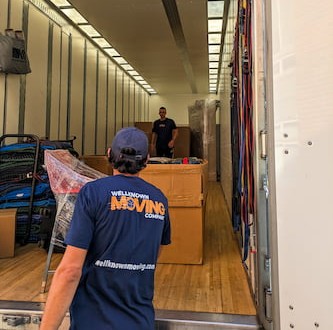
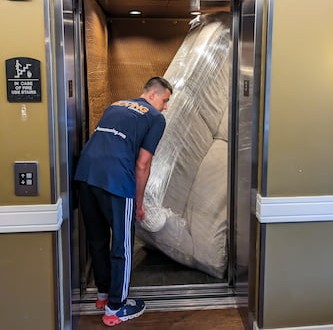
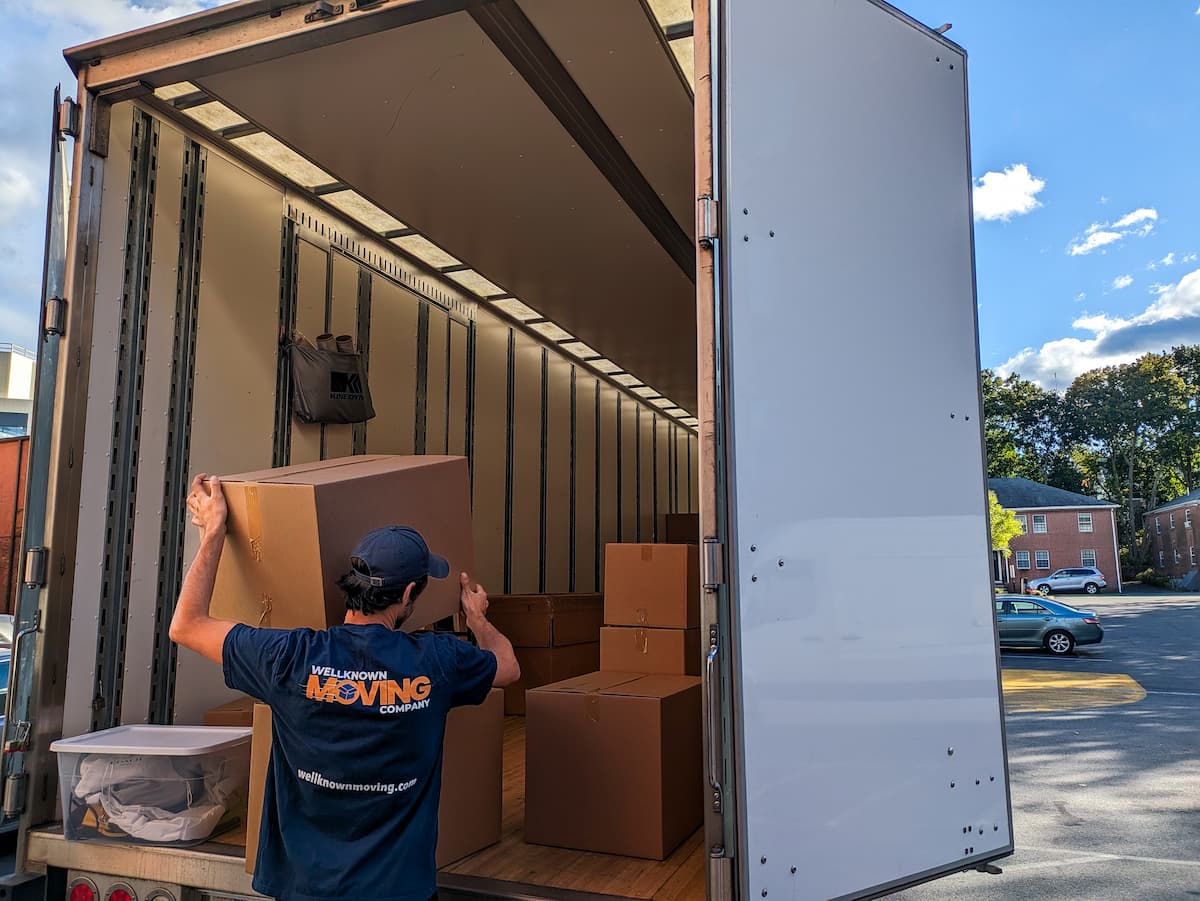
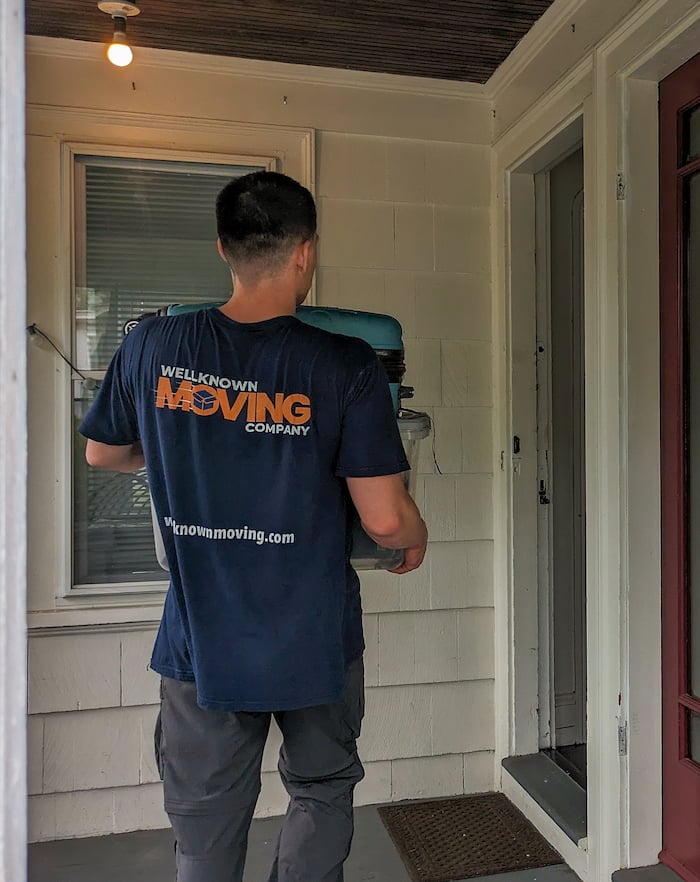
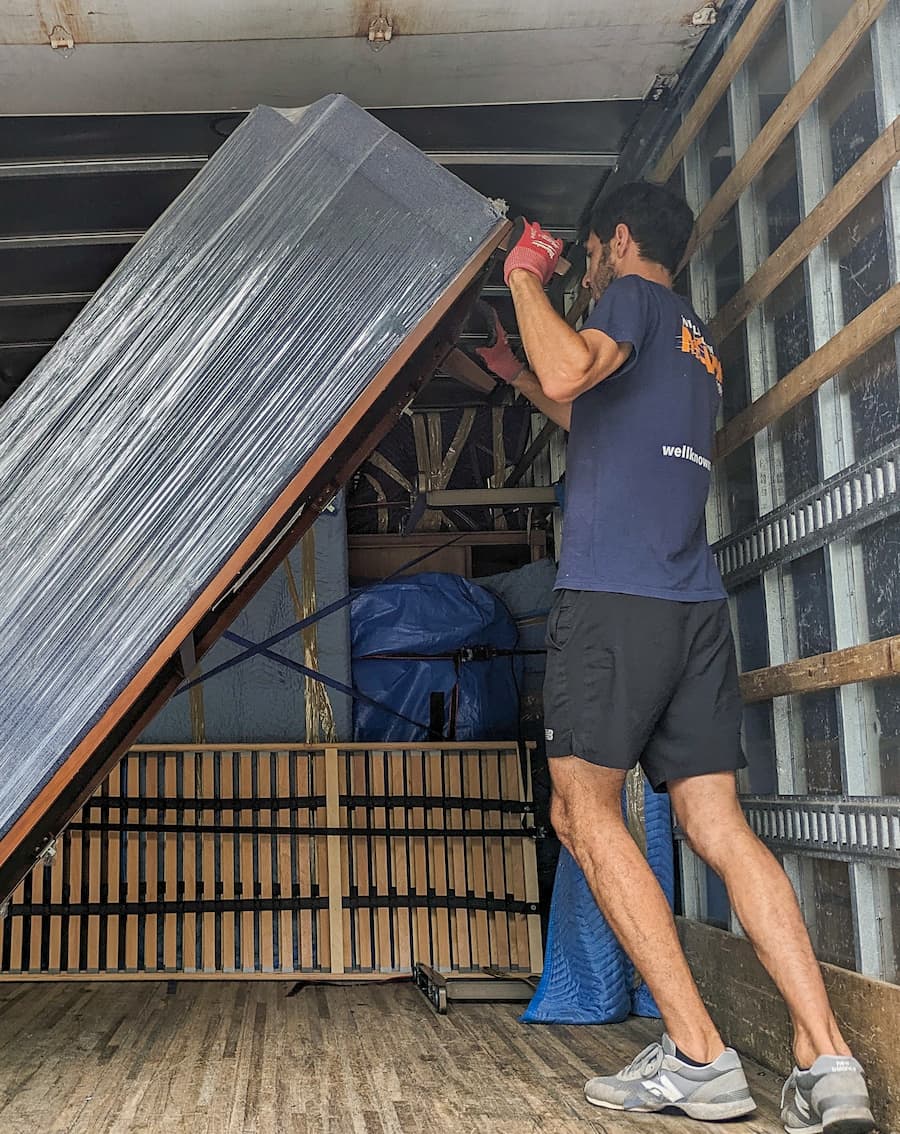
Half the houses in Des Plaines were built between 1940 and 1969, and the median one dates to 1966, on the regional planning agency's data snapshot for the city. Nearly six in ten homes here stand detached on their own lot, and most of those lots came with a single-car or shallow two-car garage. The practical result is that the basement stairway, not the front door, is where a Des Plaines move usually slows down, and the driveway is where the household's own cars already sit, so the truck ends up on the street.
Pricing follows from geography. The city places itself about seventeen miles northwest of downtown Chicago, which puts every address in it inside the fifty-mile line and makes this an hourly, non-binding job rather than a sum fixed in advance. That has a floor you can work out tonight without speaking to anyone: three hours minimum, quarter-hour increments after that, and a standard travel allowance of at least thirty minutes added to the job. A two-mover crew with a truck begins at $120 per hour on that three-hour minimum. What lifts a move above the floor is almost never the rate. It is volume nobody listed and distance nobody measured.
So the first useful thing is not a price comparison. Open the basement door and count what is down there, then walk out to the kerb and look at where a truck could legally stand. Those two answers shape the estimate more than anything said on a call. Des Plaines is worked from the company's Chicago-area operation, and the wider metro picture sits on the Chicago movers page, with the rest of the state under movers in Illinois.
What the hourly structure actually rewards
Local work here is hourly and non-binding, and the rate is set by crew size and vehicle count rather than by the job's name. A three-mover crew begins at $160 per hour, billed in the same quarter-hour increments. A four-mover crew begins at $200 per hour, with the travel time counted inside the minimum, and that is the usual shape of a full house with a basement and a garage attached to it. Five-mover crews are available and the price for them is not published, so ask instead of assuming a figure. Anything crossing the fifty-mile line stops being hourly at all and becomes a binding flat rate from $750, set from distance, exact inventory and access before the date is booked. The pricing page sets the structure out in full, and local moving and long-distance moving describe the two models separately.
Because the clock runs in quarter hours, the local conditions that push a Des Plaines move upward are all measurable in advance: how far the door sits from the closest lawful standing spot, a basement stairway that turns at a landing, a single lift shared with the rest of a building, and a winter street that has not been cleared yet. There is nothing added for stairs. Stairs still change crew size, move time and planning, which is why the awkward pieces are worth naming at estimate. Basic disassembly and reassembly sits inside the rate, beds always and other furniture as the route demands, and in a housing stock this age it gets used.
Four things have to be confirmed on their own before they count as part of the job. Packing is quoted per job in full, partial or item-specific form and is never part of a standard move. Storage attaches in one of three shapes once it is agreed: the load goes in, the load comes out, or the unit is where the move ends. Extra stops go onto the schedule before the day. Heavy and fragile items, and anything above two hundred pounds, are confirmed before the day because access, crew requirements and the protection needed can each carry an additional charge. Ask about all four during the estimate and the number you are given is the number that describes your move.
Who is responsible for what
You count the basement, the garage and the crawl space before the estimate. We size the crew and vehicle count from what we are shown. A local move is non-binding, which means a job materially bigger than the one described can move the rate, and an unopened basement is the usual reason.
You measure the carry: how far your door sits from the closest place a truck may lawfully stand. We stage the load for whatever that turns out to be. It is the one input you can change for nothing, and it runs on the same quarter-hour clock as everything else.
You notify the police department before a moving trailer goes on the street. We plan the load around the access you confirm. The code puts that notice on the resident and caps the trailer at twenty-four hours.
You read the sign on your own block and tell us what it says. We work the truck under the service exemption that covers it. Your street may be resident-only on weekdays, every day, or inside the arena towaway district.
You work out in advance where your own vehicles sit that morning. We hold the truck in one position rather than restaging mid job. On a resident-only block the crew's cars have no exemption to fall back on, so they need a plan of their own.
You get the building's insurance requirement in writing, wording included, before move day. We produce the certificate to match what you send us. Plenty of buildings never ask; the ones that do turn away anything generic at the door.
You book the lift and confirm the move-in window. We sequence the load around the window the building actually granted. Older buildings here often run one passenger elevator and no service entrance.
You submit the floodplain determination if the new address has a basement you plan to fill. We place items where you direct. The city answers within twenty-four to forty-eight hours, which is inside almost any moving timeline.
You name the pieces you already suspect will not turn on the stairs. We take them apart and rebuild them inside the rate. Nothing is charged for the stairs themselves, but they change how many people the job needs.
You tell us whether we are packing, and whose boxes and tape we are using. We price that as its own line and keep it out of the hourly work, and we bring materials if you want them. Nothing about packing happens by default.
You check the snow-route list before choosing a winter date. We adjust the start hour and staging for the conditions on the day. After two inches the snow routes close to parked vehicles, and cul-de-sacs are cleared last.
You accept that the finish time is a range. We give you that range and keep you told as it moves. It follows how the previous job finished, then traffic and weather, then whatever the lift, the building's own rules, the parking and the state of your packing add on the day.
Before move day in Des Plaines
Six things, in the order they are worth doing. None takes long and all of them change the estimate.
Tonight. Open the basement and the garage and count what is in them, room by room, including anything over two hundred pounds. Then step outside and pace the distance from the nearest spot a truck could legally stand to your front door, and look at whether eighteen feet of roadway would still be open with it there.
This week. Read the parking sign on your block, or check the resident-only and snow-route schedules in the city code, and note which of the three regimes applies. If the address is in a building, email the property manager to confirm the Certificate of Insurance wording and the move-in window in the same message. If the new address has a basement you intend to fill, submit the floodplain determination request.
Before the estimate. Decide whether packing is in scope and whether a storage stop or an extra stop is part of the plan, because each one has to be confirmed before it counts. On a larger or more complex household, ask for a virtual or in-person estimate so that inventory, access and heavy items are settled before a date is held. A local move needs no deposit to hold the date, because the hourly structure settles in full once the work is done, and 14 days' notice is what is asked for if the date has to be released.
On the day and after. Walk each room with the crew before they leave and check the pieces that were taken apart. If something is damaged, the claims form asks for clear photographs, a description of each affected piece, both addresses, and the date the move ran. Hold on to the damaged piece and whatever it was wrapped in until that review closes, because the reviewer needs to see how it was protected. The rate already carries basic liability coverage without a separate charge. Moving is physical handling, so nothing here is a promise that nothing will ever be marked.
Bring those answers when you start an estimate and the crew is sized for the move you actually have rather than the one described over the phone. Existing customers' accounts of how that went are on the reviews page.
Who tells the police, and when
Des Plaines issues neither a moving permit nor a reserved-curb permit of any kind. What it has instead is a notification duty, and the city code puts that duty on the resident. Under section 7-3-2 of the city code, a resident may place a moving trailer on the public street directly in front of the dwelling, or on the parkway, for loading or unloading, for no longer than twenty-four hours, and notification must be given to the Des Plaines police department before the trailer is parked. The allowance also lapses if the parking would create a danger to public safety.
Read the grammar of that rule carefully, because it decides who does what. The code says residents may park and notification must be given. WellKnown does not make that call on your behalf, does not reserve kerb space anywhere in the city, and does not apply for anything. What the crew does is plan the load around whatever access you confirm. If a portable container or a trailer is part of your plan, the notification has to be made before the vehicle goes on the street. Move morning is already too late, and the twenty-four hour cap means a container cannot simply sit there over a weekend.
The same section decides where a truck can stand once it arrives. A vehicle may not leave less than eighteen feet of roadway open for traffic, and in a public alley the figure is ten feet, with alley parking otherwise limited to loading and unloading alone. Older blocks near the downtown grid still have those alleys, and on a narrow one the ten-foot rule is what decides whether the alley is usable at all or whether the crew works from the street frontage instead. Hydrants need fifteen feet of clearance and no vehicle may block a driveway, yours or a neighbour's.
Blocks where the sign changes the plan
Two separate parking regimes operate inside this one city, and they treat a moving truck differently from the people driving it.
Section 7-3-9 designates resident-parking-only streets where, once signed, parking is restricted to residents' own vehicles and to service or delivery vehicles whose operators are doing business with residents of that area. Some of those streets are restricted from eight in the morning until six in the evening on weekdays, including Evergreen Avenue and Willow Avenue between Laurel and Graceland. Others run every hour of every day, weekends and holidays included, among them Cedar Street between Jarvis and Touhy, Chase Avenue, Hickory Street, Jarvis Avenue, Koehler Drive, Magnolia Street and Pennsylvania Avenue. The truck working your move is doing business with a resident, so the service exemption reaches it. The crew's own cars are not covered by anything.
The second regime is sharper. Because Allstate Arena abuts a residential district of the city, Des Plaines created a restricted resident parking district bounded by Touhy Avenue, Mannheim Road, Higgins Road and Scott Street, and section 7-3-10 makes that district a towaway zone wherever it is posted. Central Road, Curtis Street, Estes Avenue, Farwell Avenue, Greenleaf Avenue, Lunt Avenue, Maple Street, Morse Avenue, Nimitz Drive, Northshore Avenue, Pratt Avenue and Sycamore Street all carry resident-only restrictions inside it. An address in that district on an event evening is not a reason to move the date. It is a reason to say so at estimate, so crew parking is arranged deliberately instead of being solved in the first twenty minutes on site, which is setup time on the clock before a single box moves.
If the building at either end is a mid-rise
Des Plaines is more vertical than its housing age suggests. Nearly one in five homes here is inside a building with twenty or more units, and a further slice of the stock sits in buildings of ten to nineteen, on the same CMAP figures. That population needs a different conversation from the ranch owner three streets away.
Ask the property manager two questions this week. First, whether the building wants a Certificate of Insurance. WellKnown issues one when a building asks, and six details decide whether it arrives in usable form, so confirm each of them with the manager instead of guessing: the building's name, the manager to contact, the limits it wants carried, the exact additional-insured wording, the address, and the date you are moving. Wording that does not match what the manager expects gets refused at the door, which is why the exact requirement matters more than the lead time. Not every building asks for one, so it is worth checking either way.
Second, ask what the move-in window is and how the lift is booked. The older elevator buildings in this city commonly run one passenger elevator and no separate service entrance, which makes availability rather than paperwork the real constraint. The newer stock clusters downtown near the station, and there the constraint is the kerb: the city runs seven lots and about three hundred spaces at the Des Plaines station on the Union Pacific Northwest line, with the large majority sold as daily parking, and two more lots at Cumberland that are daily only. Those fill on weekday mornings. A mid-morning or weekend start near either station buys better access at no cost at all, and the city's own parking pages set out how the pay boxes and monthly permits work.
Whether the basement is the right place for the boxes
This is the question a Des Plaines page owes its readers and most moving copy skips. The city maintains a floodplain and a floodway defined against the FEMA flood insurance rate map, and it will tell you which one, if either, covers a specific property. The floodplain determination request is answered within twenty-four to forty-eight hours, and a prospective owner can submit it as readily as a current one.
That turnaround is short enough to sit inside almost any moving timeline, and the answer changes a decision only you can make. The crew places boxes and furniture where you direct. If the determination comes back and you would rather keep documents, photographs, upholstered furniture or anything with a motor above grade, say so before the truck is loaded, because placement decided at the estimate costs nothing and placement decided halfway through an unload costs time. Half this city's homes have full basements and long-tenure owners, which is exactly the combination that fills them.
Winter, and why the date matters more than the crew
A Des Plaines winter is not an exception to plan around. It is a season. NOAA's 1991 to 2020 monthly normals for the O'Hare station, which sits immediately off the city's southern edge, put normal snowfall at roughly eleven inches in January and close to eleven again in February, with normal January highs in the low thirties. May, the wettest month by normal rainfall, lands squarely in the busiest part of the moving calendar, which is why wrapping and floor protection get planned into a spring move instead of added on the day, because a wet load path marks a floor faster than a dry one.
The ordinance responds to that. Under section 7-3-8, once two inches of snow have fallen it is unlawful to park or to leave a vehicle parked on any designated snow route until clearing is finished, and the list of snow routes runs to dozens of ordinary residential streets as well as the arterials. On streets that are not snow routes, parking is barred while clearing is actually under way, and the city posts notice on the street no less than six hours beforehand. Six hours is short enough to land on the morning of a move. Vehicles left in the way may be towed or relocated, with the charges falling on the owner.
One thing this city does not have is an academic surge. Oakton College's main campus sits in Des Plaines on a 147-acre site bordered on the west by the Des Plaines River, and it operates no residence halls, so there is no dormitory move-in weekend here to book around. The calendar that matters locally is lease turnover and closing dates, which is why the date you can choose is worth choosing on the weather and the street instead of a term timetable.
Then there is the order of operations. The city clears roughly a hundred and forty lane miles and publishes its priority sequence: emergency and public facilities first, then primary routes, then secondary routes, then city parking, and cul-de-sacs, alleys and courts last. A cul-de-sac is simultaneously the hardest place to stand a truck and the last street the plough reaches. Knowing which category your street falls into lets you choose a date deliberately, or accept a longer carry knowingly. Both beat discovering it at eight in the morning.