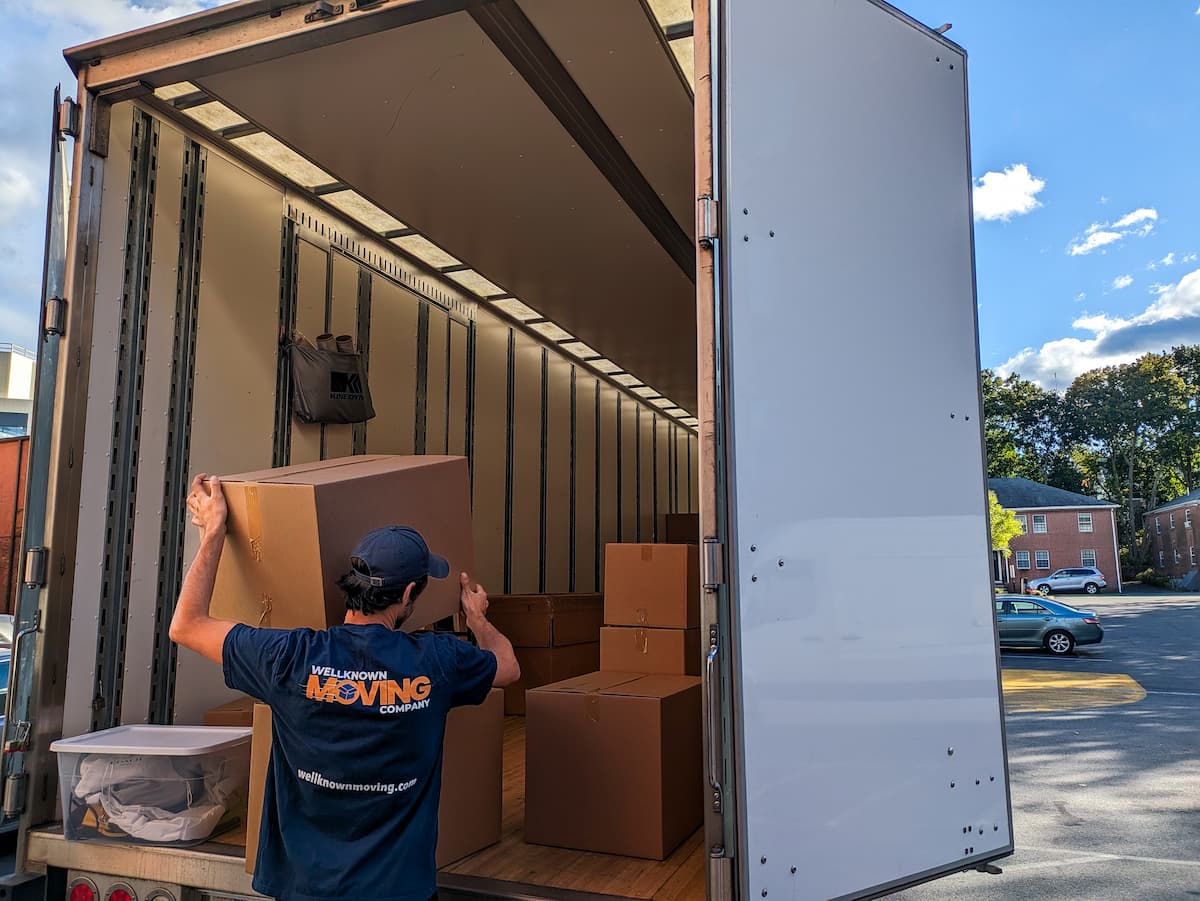
In Glenview the day of the week decides how long a moving truck can legally stand at a residential curb. Village code allows a commercial vehicle on a public way in a residentially zoned district only during the hours set aside for construction, and it identifies a commercial vehicle first of all by lettering or logos on the side. Those hours are seven in the morning to seven at night on weekdays, nine to six on Saturdays, and nine to five on Sundays.
Read those three windows next to each other and a Sunday move is eight hours of legal curb where a weekday is twelve. That gap matters here more than in most suburbs, because better than a third of Glenview homes have four or more bedrooms. A job that fits comfortably into a Tuesday can run out of daylight on a Sunday for reasons that have nothing to do with how fast anyone works.
So the first decision on a Glenview move is not which company to call. It is which day, and what hour to start. WellKnown runs Glenview out of the same operation as the rest of the metro, described on the Chicago movers page, and Glenview sits well inside the fifty mile line that separates an hourly local move from a long distance one. Everything below is written for the hourly side of that line.
Who is responsible for what
You confirm the day of the week. We set the crew size and start hour to fit it. Weekdays give twelve hours of legal curb, Saturdays nine, Sundays eight.
You check whether the date falls between the first of December and the thirty-first of March. We stage the job so the truck is off the street for those four early hours. Outside that date range the rule does not exist at all.
If it does fall inside, you call the police department's traffic unit. We supply the vehicle details you will be asked for: plate number, state of registration, the address it will sit at, and the last date needed.
You read the posted sign on your own block. We build the schedule around the hour you confirm. Sixty-two segments are closed to parking from eight to ten on weekday mornings.
You decide where the household's own cars go. We keep the truck in one position instead of restaging mid job. Commuter parking is free from eleven downtown and from four at the Glen.
You ask the building or association about a Certificate of Insurance and in what wording. We issue it once you confirm what the building wants, because wording that does not match what a manager expects gets rejected at the door. Not every building asks.
You prepare the room by room inventory, including anything over 200 pounds. We price the crew and vehicle count from it. The rate holds once confirmed; the total still follows the actual scope.
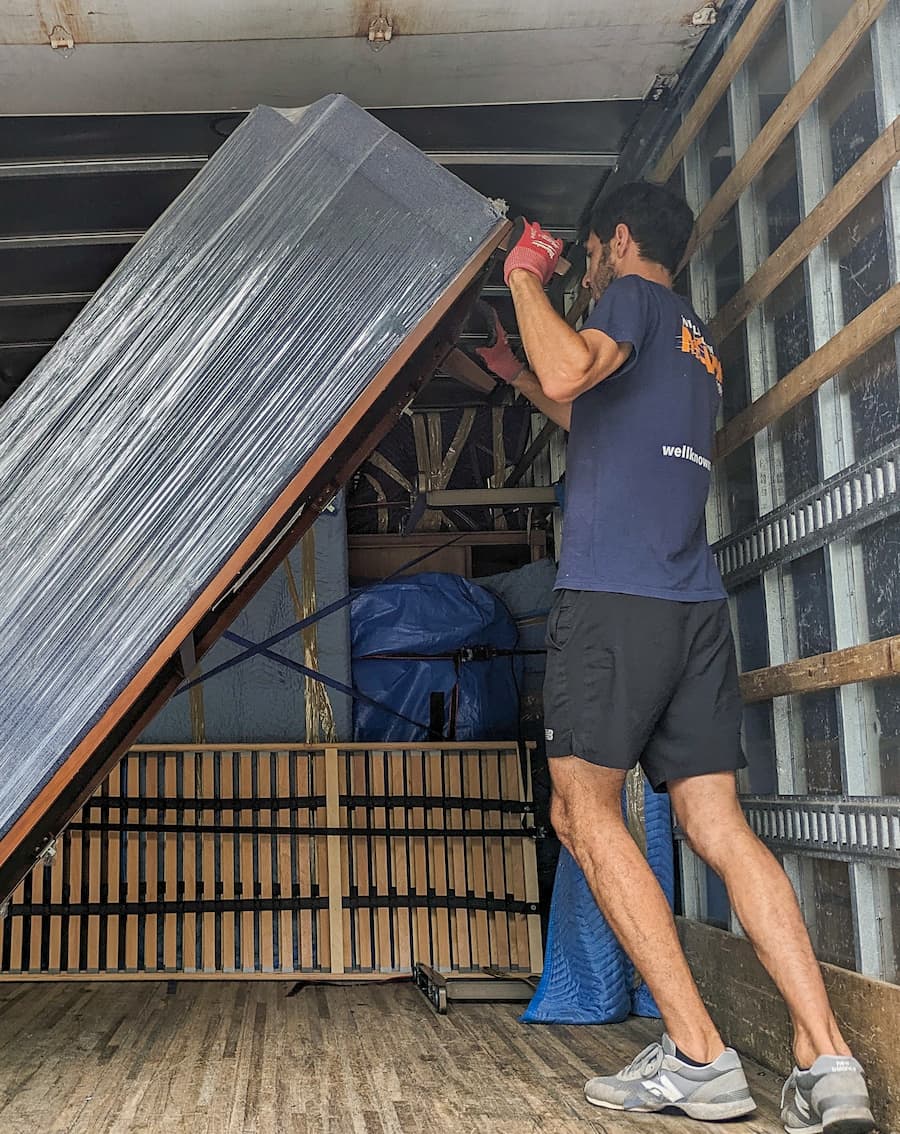
You flag furniture that was assembled in the room it stands in. We take it apart and rebuild it inside the rate, beds always and other pieces where the route demands.
You decide whether packing is part of the job and whose materials. We quote it per job and supply materials or work with yours. It is not automatic.
You say whether a storage stop is in the plan. We run it into storage, out of storage, or as the final delivery point, once it is confirmed.
You measure the carry from the legal curb position to the door. We position the truck and route the crew knowing that distance. Carry distance is time.
You point out anything fragile or heavy enough to need more than a pad. We confirm crating and padding at the estimate, and name any additional fee at that point.
Before move day in Glenview
Six things, in the order they pay off. First, fix the day of the week, because it sets the ceiling on legal curb hours before anything else is decided. Second, walk out to the street and read the sign, and if it carries an eight to ten weekday restriction, move the start to ten. Third, look at the date: if it lands between the first of December and the thirty-first of March, make the call to the traffic unit and have the plate, the state, the address and the end date ready when you do.
Fourth, ask the building or the association whether it wants a Certificate of Insurance, and ask for the exact wording rather than a yes, because a manager who says yes on the phone will still verify the wording on the document. Fifth, count the flights and the turns at both ends and note which pieces were built where they stand. Sixth, decide where your own cars will be, because a household with two cars on the block has already taken the truck's position.
Those six answers change the estimate more than anything else you can tell us, and five of them cost nothing but attention. Bring them to a written estimate, which is built from inventory, both addresses, access conditions, requested services and anything needing special handling, and comes back by email with no signature required to see the price. That is the point at which you confirm scope and we confirm the crew, so nothing on either side is assumed. If something on the list is unclear, ask through contact before booking rather than after.
Timing. A local Glenview move is planned as a range and not as a clock time, because inventory, access, the carry, building rules and the previous job all move it. The crew will give a range and update it, and will not promise an hour it cannot control.
If something goes wrong. Furniture is wrapped and protected and handling is still physical, so the route matters. Damage goes through the claims form. Send clear photographs, say when the move ran and between which two addresses, and describe what was affected; receipts or an estimated value help the review along. Hold on to the piece itself and to whatever it travelled wrapped in until the review closes, since how it was protected is part of what gets assessed.
Glenview sits within our Illinois service area, listed with the rest of the state on the Illinois page and dispatched through the Chicago operation.
Where a moving truck may legally stand in Glenview
The ordinance that governs the curb is section 90-186, and its exact wording carries the whole thing. It makes it unlawful to park a commercial vehicle on any public way in a residentially zoned district, whatever its size or plates, and it lists lettering or logos as the first identifying feature. It then permits such a vehicle on that public way during the authorized hours of construction, while the operator is engaged in work at that property.
A liveried moving truck meets that identification test on its first clause. What licenses it at your curb is the second clause, and the second clause is a clock. The village does not issue a permit for a moving truck, and it has nothing resembling a temporary curb reservation either. The Village licence and permit list runs to business registration, liquor, peddler and solicitor, outdoor dining and contractor registration, and nothing on it covers a household move.
There is an oversize and overweight permit regime, but a household move does not reach it. It starts at 73,280 pounds gross, sixty feet of length, eight feet six inches of width and thirteen feet six inches of height. A standard household truck clears none of those thresholds. So Glenview asks nothing of you on paper, and what actually constrains the job is three other things: the construction hours window, the winter overnight rule, and the sign posted on your own block.
Three smaller rules bite on move day and surprise people. A vehicle may not stand in front of a driveway, public or private, including your own, except momentarily to let someone in or out. The unpaved part of a front yard is not overflow staging. And a marked loading zone is not a berth for the day, because thirty minutes is the limit while actually loading or unloading.
WellKnown does not secure permits or clear curb space on a customer's behalf, in Glenview or anywhere else. What the crew does is plan around whatever the customer confirms. If the truck ends up parked farther from the door than it needed to be, nothing gets cancelled. The carry gets longer, and on an hourly job a longer carry is time on the clock rather than an inconvenience.
The December to March overnight rule, and the call it takes
Two Glenview moves three days apart can fall under different rules. Village code puts every public street off limits to parked vehicles for the four hours from two in the morning, and only from the first of December through the thirty-first of March. The rest of the year the street is yours. A move on the second of April and a move on the thirtieth of March are not the same job, and you can check which one you have by looking at a calendar.
Inside that window the ordinance sets out a route that most residents never discover. Someone who does not live in the village gets verbal permission from the police dispatcher on a phone call, provided they can state four things: the licence plate number, the state the vehicle is registered in, the address where it will be parked, and the last date permission is needed. The Village traffic and parking page adds the part that matters for a move. Requests running thirty days or longer go through an application. Anything shorter goes by phone to the police department's traffic unit, and no move needs thirty days.
Residents of the village who have no off street parking are handled differently again. They collect a windshield sticker at no charge, available during November each year and expiring the following thirty-first of March. That sticker also releases them from the morning restriction described in the next section. A visiting truck carries no such release, which is why the two rules have to be planned as one question.
Why an eight o'clock start can cost more than a ten o'clock one
Glenview keeps a street by street schedule of posted parking restrictions at section 90-543, enforceable wherever the signs are up. Counted through, it runs to 110 entries. Sixty-two of them are the same window: eight to ten in the morning, Monday to Friday. Another twenty-three apply on school days, most of those from eight in the morning until three in the afternoon.
The sixty-two exist because of the trains. They cluster on the residential blocks near the two Metra stations on the Milwaukee District North line, the downtown station and the Glen of North Glenview, and their purpose is to stop commuters filling those streets before the first train. A moving truck is not a commuter, but the sign does not make that distinction.
Put that beside how a local move is billed and the consequence is arithmetic rather than opinion. A local job carries a three hour minimum, bills in fifteen minute increments after that, and has thirty minutes of travel time added to it as a floor. A crew that starts at eight on one of those sixty-two segments spends the first two hours of that minimum in a position the sign prohibits. Starting at ten removes the conflict and changes nothing else about the job.
There is a second option that costs nothing. Commuter parking at both stations is free of permit and daily fee from eleven in the morning downtown and from four in the afternoon at the Glen, on weekdays, and free all day at weekends. Moving the household's own cars there clears the residential curb for the truck instead of competing with it.
Two Glenviews, and the move each one produces
The median Glenview home was built in 1977, and that median hides the thing that matters. According to the Chicago Metropolitan Agency for Planning community data snapshot, better than a third of the village's housing went up between 1940 and 1969, and almost exactly the same share went up in 1990 or later. Fewer than one home in twenty-five predates 1940. Glenview is not an old North Shore village with some new building at the edges. It is two housing stocks of nearly equal size, and they produce two different moves.
The post war third is ranches, split levels and Cape Cods. What slows a move there is rarely the volume. It is the geometry: a split level landing that will not let a box spring turn, an attached garage too shallow to stage from, basement stairs with a turn at the bottom, original interior openings narrower than a modern sectional, and bedroom furniture that was assembled in the room and cannot leave it whole. Taking that furniture apart and rebuilding it is covered by the rate, with beds always included and other pieces handled where the route demands it. What it does change is crew size, so the estimate has to know how many of those pieces there are.
The newer third is mostly attached. Roughly one Glenview home in eight is an attached single family house, more than double the rate across Cook County, and a large part of that came from one place. The Naval Air Station closed after the Department of Defense announced it in 1993, and the village took on the redevelopment itself, receiving 1,121 acres in 1997 and building out 1,969 homes on it. That build out included 567 single family houses, 729 multifamily units and 673 units of seniors' housing, plus 154 for sale townhouses ringing the town centre and 181 rental apartments sitting above its shops.
Each of those is a different access problem. Attached houses mean shared drives and rear loaded garages. Apartments above retail mean no curb of your own and a service route shared with shop deliveries. A seniors' community means a managed move window and, often, a downsizing job where the decisions take longer than the carrying. Roughly a sixth of Glenview households live in a large building instead of a house, and large buildings are the ones that tend to want a Certificate of Insurance, because a manager will verify a vendor's cover before releasing a service door.
WellKnown issues a Certificate of Insurance where a building wants one, and to write it needs the building's name and whoever manages it, the limits and additional-insured wording that manager expects to see, and the date and address the certificate should name. Not every Glenview building asks, so confirm it with whoever runs yours before you assume either way. The ones most likely to are the large managed buildings, the apartments over the shops at the town centre, and the seniors' communities. Ask early, because the answer arrives from the building rather than from us.
What the hourly rate covers, and what moves it
A Glenview move is inside fifty miles of the servicing city, so it is priced hourly and the estimate is non binding rather than a fixed sum. Two movers and a truck start from $120 an hour, with the three hour minimum, the fifteen minute increments after it and the thirty minutes of travel time all counted in. Four movers and a truck start from $200 an hour on the same terms. Five mover crews are available for larger jobs; there is no published rate for one, so the crew is named at the estimate and the number comes with it. Full detail sits on the pricing page.
Those three numbers are what let you work out your own floor before you speak to anyone. The cards further down this page set out everything the rate already carries, so none of that is repeated here. What the rate does not carry is the part that catches people out in Glenview.
Stairs are not billed as their own line. They still decide how many movers the job wants and how long it runs, and on an hourly job that is where they show up instead.
Packing is priced job by job and sits outside a standard move, so nothing gets packed by default. Storage can take goods in, hand them back out, or be the place the move finishes, but it exists only on a job where somebody agreed it in advance.
Weight and fragility can also add to the number. What drives that is how a given piece has to be handled: whether it wants extra padding or a crate built around it, how many movers have to be under it, and whether it clears the door at all. Past 200 pounds, that discussion belongs to the estimate and not to the morning of the move.
In Glenview specifically, three conditions push a job toward the upper end. A long carry from a legal curb position to a deep set door, because the village gives a sixth of its land to open space and the block faces are longer than they photograph. A high disassembly count in the post war stock. And a start hour forced late by a posted sign, which shortens the working day inside an already fixed window.