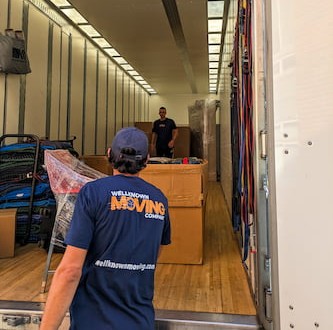
The Northbrook move depends on a question most people don’t bother to ask: Who owns the street outside the door? Most of them are plowed by the Village. On the Village’s own list of other government jurisdictions, Cook County services Sanders Road and portions of Walters, Techny, Landwehr and Sunset Ridge. Some of the streets here are private and owned by an association. And some Northbrook addresses are not in the Village at all. Northfield Township maintains a roadway district out in the unincorporated pockets. One question, four possible answers.
That matters because the answer determines which rulebook applies to the truck, who to call when the lane is blocked and who is plowing in February. The Village’s Know Your Neighborhood map settles it by address, and is linked from the street and roadway plowing page along with the four agencies it might name. The first thing to do is that lookup, which takes about a minute, ahead of packing lists and ahead of dates.
The rest is all arithmetic which you can do for yourself. The village sits 25 miles north of downtown Chicago, on the Village’s economic development page. That distance puts a Northbrook job squarely within the 50-mile line, so it is priced by the hour on the basis of crew size and vehicle count, rather than as a sum fixed in advance. From the company yard in the metro, crews reach the North Shore. The Chicago movers page has the wider region covered and the Illinois hub has the other markets served in this state.
Who is responsible for what
Moving goes wrong when nobody has decided who owns a detail. So here is the full split. Look down the left column. The first row you can’t yet answer is the call worth making first.
At both ends you check who’s got power over the street. We plan the truck position based on the answer. The Village is the wrong desk to call on a county stretch like Sanders Road. On a private street, the association's rules take the place of the Village's.
You verify whether the address is within the Village or unincorporated. We play by whatever rulebook is in effect. A Northbrook mailing address does not constitute proof of a Village address.
You choose where the truck will be and what the fallback is. We take the shortest legal carry on the day. On an hourly job it is a longer bill. Under section 24-110 a longer carry is a longer stand.
You confirm that nothing should be on the street between two and six in the morning. We plan loading and travel within the legal window. The only way to get around it is with the written permission of the village manager.
You give the number of rooms, the turns of the stairs, and the largest single object at either end. We recommend a number of crews and vehicles against that. An undersized crew adds hours at the same rate.
Ask your building or association if it needs a certificate of coverage and what wording it needs. You tell us six things: building name, property manager contact, coverage limits, the additional-name wording the building requires, the move date and the address. We issue it. Many buildings don't ask. If one does, it usually requires the certificate several days in advance.
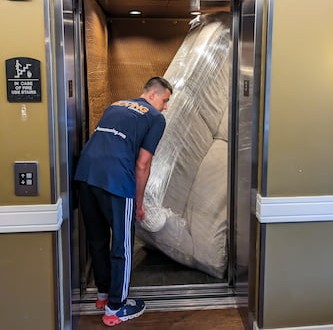
You reserve the lift or service-door window, say when it opens and closes. We sequence the load of it. If a window expires mid-load, the rest wait and waiting bills in fifteen-minute steps, like everything else.
You check the forecast and find room for a winter date in the driveway. We recommend the pace a cleared driveway allows. Over two inches in a day the street is not an option. The truck is towable with no warning.
Anything heavy, or fragile, or over 200 pounds at the estimate. We confirm the handling, protection and any additional fee before the date. A safe or marble top on move day will change the crew requirement as the padding or crating must be verified before scope is set.
You choose the amount of packing, and whether it is ordered or not. There is no published price per box so we quote per job against the rooms and materials. A storage leg, a second address or loading help in the same way.
You keep documents, keys, medication and valuables off the truck. We load and secure what is listed in the verified inventory. Anything the crew never saw is not on the inventory and the inventory is what a later claim gets read against.
You walk every room, closet, basement and garage before the crew departs. We put things on the plan and wait for that walk-through. Note any loss or damage on the inventory or bill of lading, on our copy, too. Hold the item and its packing until the review is complete. Our form is at claims. The Commission’s guide states that the Illinois filing window is 90 days from the date of delivery.
Before move day in Northbrook
There are two things on the normal Illinois checklist that do not apply here, and both save time if you know beforehand. Northbrook has no real estate transfer tax and the village does not issue transfer stamps, so there is no village stamp to chase down prior to a closing. And on the first of May 2026 the annual village vehicle sticker was discontinued. Nothing to buy, nothing to display, nothing to transfer. You can find both on the Village’s new resident page.
The change of sticker has a moving day feel. On the Village’s notice that stickers were discontinued, resident-only parking at the East, West and North commuter lots is now checked by license plates against village addresses, and non-resident plates are held to two numbered bands of spaces. A household in the process of changing its registration can be read as non-resident for a time. Anyway, those lots are not overflow for a move. Section 24-134 prohibits trucks of more than two-axle design and trailers of any kind from municipal off-street lots.
The short list, in the order it likes:
- Please run both addresses through the Village’s Know Your Neighborhood map and write down which authority owns each street.
- If either comes back private or county, ask that association or that department what it takes for a moving truck and ask this week rather than the week of.
- Choose if the crew goes through the front door or the garage. Count the number of stair turns on the winning route.
- Ask your building or association if it requires a certificate of coverage and the specific language it wants in writing.
- If there is a service door window or elevator, book it and take note of when it opens and closes.
- Anything over 200 lb and anything fragile enough to require crating should be listed so it is priced before the date arrives.
- Settle the pack. A late booked partial pack is the change that most moves a schedule.
- Find out who collects your rubbish. Most Northbrook households use the village hauler, although some condominium and apartment buildings have their own contracts, and that determines where a hundred flattened boxes can legally go the week after.
- For a winter date, clear the driveway the night before and keep the apron free of the plow ridge.
Have those answers ready when you ask us for an estimate, and confirm anything you’re unsure of first, because those answers will change the crew size and hours more than any other detail.
Four agencies plow Northbrook, and only one of them is the Village
The Village's plowing page lists them by name: the Village of Northbrook, the Illinois Department of Transportation, the Cook County Department of Transportation and Highways, or, on a private street, your association or property manager. Each has its own reporting route, and Cook County's highway department alone is responsible for maintaining 568 centerline miles of roads throughout the county.
That’s a huge difference on a move. A call to the Village about an obstruction, a blocked lane or an unplowed surface on a county-maintained stretch goes to the wrong desk. The Village sections below don’t simply reach. The association writes the rules about truck access and guest parking on a private street. In unincorporated areas, the township and county perform the functions that would otherwise be carried out by the Village.
So run the address through the Know Your Neighborhood map for both ends of the move, and tell us what it says. If it comes back county or private, the second call is to that authority or that association, and is worth making as soon as the date is selected.
The rule on your street is a clock, not a permit
Northbrook does not issue moving permits. Nowhere in its entire schedule of village licenses and permits, from business licenses to solicitation, construction trades, home occupations, liquor, food trucks, outdoor seating, special events and taxicabs, is there a moving entry or a temporary no-parking entry. Duration, however, is what controls. It’s found in two sections of the traffic chapter of the municipal code.
Section 24-110 prohibits the parking of a commercial vehicle in a residential zoning district for more than is necessary for reasonably expeditious loading and unloading. Section 24-112 then prohibits a business vehicle or a trailer from every public street in the village for the four hours after two in the morning, except when authorization is granted by the village manager in special and unique circumstances. You write to the manager's office and ask for it. There’s no form, no published fee and no published lead time.
Read those two together, and the legal test is time. It may be standing while the truck is working and no longer. And that is the same unit the bill is running on because the local job is billed in fifteen-minute increments after a three-hour minimum, with thirty minutes standard travel time the least that gets added. The shorter the carry, the shorter the legal stand and the invoice, so it pays to settle early, whether the crew comes in the front door or the garage. Those are two different routes with two different stair turns in a house built in the decade that dominates Northbrook's stock and the shorter one is not reliably the one people expect.
One of the pitfalls is in the definitions. Section 24-110 lists a gross weight over 8,000 pounds. That sounds like an exemption for anything smaller. Section 24-113 destroys it: a business vehicle is defined regardless of registered gross weight and is recognized either by a name or logo visible from the outside or by business materials visible from the outside. Any truck in livery qualifies at any weight. A plain rental truck with pads, dollies and shrink wrap stacked against the back door is arguable, and arguing it at the curb is not where anybody wants to be.
Three smaller provisions in the same chapter change plans more often than you think. Section 24-111 requires two right wheels within twelve inches of the curb line, so angling a truck across an apron to shorten the carry is out. Section 24-107 prohibits leaving an alley with less than ten feet of usable roadway or blocking the entrance to an abutting driveway. Section 24-104 closes a street to parking for a cleaning, with signs posted at least twelve hours in advance, short enough that a sign can go up the night before a move booked back in March.
A four-bedroom house is a crew-size question before it is a price question
Northbrook housing is different from the surrounding county. Here, the median unit has a little more than seven rooms, compared with closer to five countywide. Nearly half of all units here have four bedrooms or more, compared with about one in six in Cook County. Almost seven in ten of the units are detached houses and almost nine in ten are owner occupied. Those numbers come from the Chicago Metropolitan Agency for Planning’s data snapshot for the village.
That changes what the hourly model is rewarding for. Most people are accustomed to a friend's move with two movers, and against that number a Northbrook quote looks inflated. Also, it’s the wrong comparison. Crew size and number of vehicles are chosen with you from the inventory and the access. And on an hourly job, an under-sized crew doesn’t save money, it spends more hours at the same rate.
The published floors are easy to keep in your head, and each one is a floor, not a quotation. The published floor is a two-mover crew with a truck at $120 an hour, and every local job opens on a three-hour minimum. Once you reach that minimum, it's billed in fifteen-minute increments. A three-mover crew is $160 an hour. For a four-mover crew the floor is $200 per hour with thirty minutes of standard travel time sitting inside the day on top of that. The selection process is the same here for the large houses, but they do have five-mover crews available. There is no hourly number published for a five-mover so no one should be quoting you a number for one. You can read all about pricing on the pricing page.
In Northbrook, it’s rarely the rate that makes a bill. It’s a basement or garage no one listed, a split-level stair turn a sofa can’t clear, or a driveway that leaves the crew carrying ‘from the street’. Count the rooms. Count the turns of the stairs. At either end. Name the largest single thing. Heavy and fragile items over 200 pounds such as a safe, piano, marble top or glass table will be subject to an additional fee depending on the crating and padding involved and therefore need to be confirmed at estimate.
Packing is a separate decision, not a standard job. It is quoted job by job against the rooms and materials and confirmed before date rather than assumed. A storage leg, a second address or loading help without transport are all confirmed in the same manner. Once the move crosses the 50-mile line it stops being hourly and becomes a long-distance job, priced as a binding flat rate from $750 against distance, inventory and access.
What the state regulator says an estimate actually is
Anyone moving household property for hire in Illinois must have a household goods license from the Commerce Commission. The Commission has a licensee search you can run against any mover before you sign. Its consumer guide for household moves also specifies how a job that stays within Cook County can be billed: by crew headcount and hours needed to do the work. This is the model that this page has been talking about all along.
Same guide is blunt about what an estimate is worth. It says that an estimate is not binding, that it is a general idea of charges under normal conditions and that the bill follows the service actually performed. A lot of people read that as a warning and they stop. It's a better instruction, because it defines specifically where the leverage is: in the inputs. And then, get the estimator across the basement, the attic and the garage, and say out loud what the destination will do to the day, meaning the stairs, the elevator and the walk from the curb.
The guide establishes one more protection worth knowing. If the charges are higher than the written estimate you were given, paying ten percent above that figure obligates the mover to unload and deliver everything, with thirty days to settle the remaining balance. The rule protects your possession of the property and buys time for settlement. It doesn't restrict how much a move can cost and a page describing it as a cap has misinterpreted it.
WellKnown runs interstate work under USDOT #4224986 and MC-1633615 which you can pull as a carrier snapshot in SAFER before anyone loads anything. A carrier is not a broker because the moves are serviced by company employees who are dispatched from company yards in company trucks as opposed to being sold to whoever is available. The Commission’s tip sheet on hiring a household goods mover is a short, useful checklist to run against anyone you are considering, including us.
Two inches, and the truck stops counting as parked
Northbrook snow rule is automated. Section 24-11 states that a snow emergency shall be declared when two inches accumulate in twenty-four hours, and the director of public works may lift that emergency only after operations are completed. Section 24-12 provides that in that emergency any vehicle standing on a public street is a hazardous vehicle, and section 24-52(b) allows a hazardous vehicle to be towed immediately. No warning stage. No ticket-first courtesy. The only block that is exempt in the entire village is the on-street facility on the north side of Milton between Keystone and Angle.
That clock around it is also published. Plowing begins when accumulation reaches an inch and a half to two inches, and the Village’s goal is to have streets cleared curb to curb and salted within four to six hours of snow ceasing to fall. Due to the lake, the Chicago area has the heaviest of it. According to the Illinois State Climatologist's account of the state's climate, Northern Illinois averages about 36 inches of snow a year. Three feet a season against a two-inch trigger is not uncommon to plan for. It is a normal winter.
So, a different plan for a December to March date here. The driveway is now the primary place, the street is fallback, reversing how most moves are planned. And keep it clear the night before, because a windrow across the apron will hold a loaded truck as well as a snowbank. Section 24-9 separately prohibits pushing driveway snow into the roadway, so the pile has to go somewhere on your own ground. And the map might say that your street is either county or private, but the four-to-six-hour target is the Village’s and might have nothing to do with how fast your surface is cleared.